Friday, April 24, 2020

Program Spotlight: SafeShelby

SafeShelby Sexual Assault Services is a program of SafeHouse of Shelby County. SafeShelby opened in December of 2016 to provide forensic medical exams and support advocacy to victims of sexual assault commonly known as a SANE exam. In 2019, SafeShelby began conducting forensic exams for intimate partner violence and strangulation. A team of five nurses and six advocates are specially trained and ready to serve victims of sexual assault 365 days a year 24 hours a day. SafeShelby serves Shelby, Chilton, Clay, and Coosa counties for sexual assault. All of SafeShelby services are at no cost to you.


Who Can Seek Services?
Anyone ages 14 and older who has experienced a sexual assault, physical assault by an intimate or dating partner, and/or strangulation. SafeShelby staff can respond to the hospital should you need medical attention and are unable to get to our clinic.

What is a SANE exam?
A SANE exam is a comprehensive forensic exam performed by a specially trained nurse following a sexual assault. You will be greeted by an advocate who will escort you to a cozy room where the nurse will conduct a history taking. You will be asked basic information about your health and asked to share details of the assault. This will help the nurse know where on your body to look for injuries and collect evidence.

Throughout the exam, the nurse will be looking head to toe for injuries and taking photographs. At the conclusion of the exam, the advocate will offer for you to take a shower,if you would like one, and provide you with all new clothing.


Following the exam, you will be offered medications as a prevention measure for sexually transmitted infections and emergency contraception. While the thought of having a “Rape kit” done can be fearful and scary, our team of nurses and advocates go above and beyond to make sure you feel safe and comfortable. You are in control of the exam and have a right to stop at any time.

What is Advocacy?
Because victims who work with advocates suffer less distress and are more likely to experience better emotional health in the future, SafeShelby’s volunteer sexual assault advocates provide essential services to victims of sexual violence.  During the SANE medical exam and other supportive services, advocates offer beneficial information and compassionate emotional support allowing victims to better understand their rights and make informed choices.  Should victims choose to file police reports, advocates can provide accompaniment when talking to law enforcement officers and should the case go to trial.

SafeShelby’s advocates complete twenty hours of comprehensive training on trauma-informed approaches for assisting victims and practice interacting in ways that promote healing and prevent re-traumatization.  SafeShelby will be hosting advocate training sessions this summer, dates to be announced.  Caring individuals interested in serving as volunteer advocates may apply by contacting LeAnne Knight at leannek@safehouse.org.


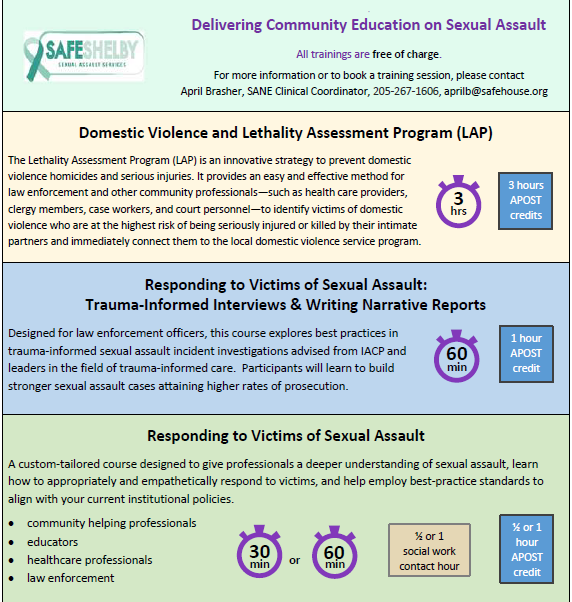
 Workshops and Training Provided


Wednesday, April 22, 2020

Program Spotlight: Prevention Team


What would you say if a friend told you they had been raped? Do you know how to respond if a family member confided in you about an abusive relationship? Could you tell them where to find help?

Most people would probably answer no to all of those questions. That’s okay. It’s an extremely difficult conversation and not one that we have often.

One of the goals of our Prevention Team is to help you answer those questions. Our Prevention Team also wants to educate the community on the dynamics of domestic violence and sexual assault to prevent future abuse. They offer a variety of trainings and presentations.  

How to Help sessions are exactly what they sound; we talk to the audience about how to help someone who has been a victim of interpersonal violence. This one-session presentation is great for churches or other helping organizations who may encounter victims. Family members of victims can also have individualized How to Help sessions with our counselors.

Domestic Violence 101 will cover the basics of domestic violence- the cycle, different types of abuse and warning signs of an unhealthy relationship.


In Her Shoes is an interactive activity that can be added with almost any of our presentations. In Her Shoes asks participants to make decisions based on actual domestic violence scenarios. The experience opens the eyes to the different barriers victims face when trying to leave an abusive relationship. We also have a special In Her Shoes for teenagers and dating violence. It’s great for youth groups and college students.

The 4th R is a 4-session group for high school and college students revolving around the issue of dating violence. Our Prevention Specialist can condense sessions making it easily adoptable for school, youth groups or after school programs.  


*Coming Soon* Bringing in the Bystander is our newest training that we can’t wait to roll out! This curriculum teaches participants how to recognize and safely intervene on behalf of potential sexual assault victims. This versatile presentation can be altered to fit a workplace, a college party and everything in between.

Don’t wait to book a presentation! Our Prevention Team is scheduling for summer and fall. Reach out to Sarah, our Prevention Program Coordinator at sarahr@safehouse.org for more information or to book a training.

Tuesday, March 31, 2020

Mindfulness and Meditation


We are living in a lot of uncertainty right now, and that can add to the everyday stresses we already feel. Despite everything going on in the world, it’s important to try our best to stay positive for the sake of both physical and mental health.

It’s not easy to do that, but the SafeHouse counselors want to offer some advice.

“Don't forget to make the effort to take care of yourself- Take a bath, put your food on a nice plate that looks appealing, sit outside and enjoy the outdoors for a few minutes, call and check on people you care about.” Katy, our Domestic Violence Counselor also recommends taking time for something you love. “What do you enjoy- playing with your pet? Watching a movie with your kids? Taking a bath by yourself? Talking on the phone with a friend? Try to do something relaxing just because it's something you enjoy.”


Some people find mindfulness exercises helpful. Here are a few favorites of Ashlie, our Sexual Assault Counselor (pulled from PsychCentral by Leonie Stewart-Weeks). 


Yawn and stretch for 10 seconds every hour.
       Do a fake yawn if you have to. That will trigger real ones. Say “ahh” as you exhale. Notice how a yawn interrupts your thoughts and feelings. This brings you into the present.
Then stretch really, really slowly for at least 10 seconds. Notice any tightness and say “ease” or just say hello to that place (being mindful — noticing without judgment). Take another 20 seconds to notice and then get back to what you were doing.

Three big breaths exercise.
       Take 3 big breaths together with a loved one. Even if they don’t breathe with you, your breathing will ground them

           Stroke your hands.
Lower or close your eyes. Take the index finger of your right hand and slowly move it up and down on the outside of your fingers. Once you have mindfully stroked your left hand, swap and let your left hand stroke the fingers of your right hand.

      Mindfully eat a raisin.
Take a raisin or a piece of chocolate and mindfully eat it. Slow down, sense it, savor it and smile between bites. Purposefully slow down. Use all your senses to see it, touch it, smell it, and sense it.
Then gently pop it into your mouth and really savor it. Savor its texture, its taste, how it feels in your mouth. Let it linger and then swallow it. After you have swallowed it, let your lips turn up slightly and smile. Do the same thing for each raisin you eat or bite you take.

      Clench your fist and breathe into your fingers.
Position your fingers and thumbs facing down. Now clench your fist tightly. Turn your hand over so your fingers and thumbs are facing up and breathe into your fist. Notice what happens.

      STOP.
Stand up and breathe. Feel your connection to the earth.
Tune in to your body. Lower your gaze. Scan your body and notice physical sensations or emotions. Discharge any unpleasant sensations, emotions or feelings on the out breath. Notice any pleasant ones and let them fill you up on the in breath.
Observe. Lift your eyes and take in your surroundings. Observe something in your environment that is pleasant and be grateful for it and its beauty.
Possibility. Ask yourself what is possible or what is new or what is a forward step.
If you find yourself being reactive, try the following steps:
Pause and take one to three big breaths.
Say “step back.” (You don’t have to physically step back, you can just do it in your mind.)
Say “clear head.”
Say “calm body.”
Breathe again. Say “relax,” “melt” or “ease.”

      Mindful breathing for one minute.
Lower your eyes and notice where you feel your breath. That might be the air going in and out at your nostrils or the rise and fall of your chest or stomach. If you can’t feel anything, place your hand on your stomach and notice how your hand gently rises and falls with your breath. If you like, you can just lengthen the in breath and the out breath or just breathe naturally. Your body knows how to breathe.
Focus on your breath. When your mind wanders, as it will do, just bring your attention back to your breath. You might like to say ‘thinking’ when you notice your thoughts and just gently shepherd your attention back to your breath.
This can be done for longer than one minute. However, even for one minute it will allow you to pause and be in the moment. Or you might just like to breathe out stress on the out breath and breathe in peace on the in breath.

           Loving-kindness meditation.
For one minute, repeat ‘May I be happy, may I be well, may I be filled with kindness and peace.’ You can substitute “you” for “I” and think of someone you know and like, or just send love to all people.

      An aspiration.
Decide on an aspiration. Just ask yourself this question: What is my heart’s aspiration? Pause for about 20 seconds. Do this a second or third time and write down what comes. Perhaps it is to come from love, or to be kind to yourself or others or to be patient.
Once you decide which aspiration you like best, say that at the beginning of the day. This will set you up for your day and your interactions with others (and even with yourself).


Katy likes the following two meditations: 


SafeHouse of Shelby County is a full-services domestic violence and sexual assault response center. We are taking necessary precautions to keep clients and staff safe during the COVID-19 crisis. All of our services are currently available to those in need. Call (205) 669-7233 for emergency shelter and sexual assault exams. Email safehouse@safehouse.org to get connected to counseling, case management or legal advocacy services.


Friday, February 28, 2020


“Why doesn’t she just leave?”

It seems simple. Why stay in an unhealthy and dangerous relationship? Leaving the abuser will fix everything.

Except, far too often leaving doesn’t fix anything.


Ending an abusive relationship can be dangerous, and we recommend having a plan before leaving. We call this safety planning, and it's important to have safety plans before, during and after separation. Some victims of domestic violence feel safer in the home with the abuser because of the fear of what the abuser may do if they leave.

Domestic violence follows a pattern, and it's important to recognize each stage. Abusive relationships are not bad all the time. There is a "calm" or "honeymoon" stage when everything seems fine in the relationship. But it is after the calm when the abuse starts to happen. Breaking the cycle is hard because a honeymoon stage is safe and happy. There can easily be false hope that the honeymoon stage will last and that the abuse is over. Often, the domestic violence cycle is normalized because healthy relationships also have conflict and honeymoon stages.


So, why doesn’t she just leave? Very likely she has tried. Most victims of domestic violence will leave an average of 7 to 8 times before completely separating. There are many other barriers in addition to what is discussed here.


Let’s do what we can to make leaving safer and easier for them!
  • Believe victims when they disclose abuse.
  • Tell them about SafeHouse or whichever domestic violence response center that serves their county.
  • Help with transportation. Offer a ride to the domestic violence shelter or take the victim to work each day.
  • Baby-sit their kids or help take care of pets.
  • Volunteer or donate to your local domestic violence response center. 


SafeHouse serves domestic violence victims in Shelby, Clay and Coosa counties. Call our 24/7 crisis hotline to seek shelter or to learn more about our resources.

(205) 669-7233

Thursday, February 13, 2020

#RelationshipGoals


As you may already know from following our social media accounts, February is Teen Dating Violence Awareness Month (#TDVAM). Our Education Specialist took over the Instagram and Facebook pages to educate our followers on this issue. She worked hard to create the amazing graphics you have been seeing the last couple of weeks.


Why is it so important to our Prevention Team to spread the word about TDVAM?
As the Education Specialist has explained, “Young people (ages 11-24) who are in abusive or unhealthy relationships are at a higher risk of experiencing domestic violence (DV) in relationships they have as adults. Teens and young adults often think some behaviors, like teasing and name-calling, are a ‘normal’ part of a relationship—but these behaviors can become abusive and develop into serious forms of violence.”

We encourage all parents and guardians to take signs of dating violence seriously, because the dating habits teens form often follow them into adulthood. Teens deserve to have healthy relationships now and in the future.


What can you do if you think your teen is experiencing dating violence?   
·         Listen and support your teen.
o   Be patient.
o   Remember it is not their fault and be sure to tell them so.
o   Try to stay calm while having the conversation.
·         Believe your teen if they open up to you first.
o   Don’t minimize the abuse.
·         Show concern.
o   “You don’t deserve to be treated like this.”
·         Focus on the behavior of the person.
o   “I don’t like the way he/she treats you.” Instead of “I don’t like him/her.”
·         Avoid ultimatums, such as threats to punish your teen if they don’t stop dating the person.
·         Be prepared.
o   Educate yourself and practice talking to your teen BEFORE this happens.


What to learn more? Here are some great resources:  


Our Prevention Team is available to speak at high/middle schools, colleges, churches, community groups and businesses. Contact one of our staff for more information.

Sarah, Prevention Program Coordinator sarahr@safehouse.org
EP, Education Specialist epcade@safehouse.org

Thursday, June 13, 2019

Sponsor-A-Room

One of the most important services we offer to victims of domestic and sexual violence is a safe place to stay while fleeing the abuser. This is the most dangerous stage of domestic violence as 75% of deaths that occur from an abusive relationship happen while the victim is leaving or shortly after separation from the abuser. 

For many, the emergency shelter is the first place they have felt safe in a long time. Located in a confidential location, the SafeHouse emergency shelter was built in 2007 and was designed to look like a home. A spacious living and dinning room area overlooks the backyard with a swing set and a playground. Residents have access to a kitchen and patio area. Soon a pavilion will be complete where residents can have picnics and grill out.

But after housing an average of 200 women and children each year, the shelter is need of some improvements. It is time for new coats of paint, decorations and furniture.  

Each room has a private bathroom.
This is how most rooms are currently. 

Fleeing domestic and sexual violence is a terrifying and overwhelming experience. Giving victims a comfortable and welcoming place to come empowers and strengthens them.

The first room to be sponsored 


Our friends at BB&T Pelham have put a lot of hard work into this beautiful room.


There are a total of 12 rooms in our emergency shelter. We are looking for sponsors for 10 of those rooms. There are 3 levels of sponsorship that you, your church or organization can consider.


Level 1- Support $700 
  • paint 
  • blinds/shades 
  • 2 chests of drawers/dressers 

Level 2- Hope $1,100 
  • All items in Level 1 
  • blankets/comforters 
  • sheets
  • pillows
  • bath towels 
  • shower curtain 
  • bathroom items 
  • one additional chests of drawers/dressers 

Level 3- Empowerment $1,500 
  • All items in Levels 1 and 2 
  • lamps
  • rugs
  • artwork
  • plastic storage bins
  • hangers 
  • toiletries 

Sponsors will be recognized on our website and social media pages. You will also receive a plaque on the room door.

Want to help but can't afford one of the levels above? No problem! There are several ways to help sponsor a room. We also need volunteers to help paint, move the furniture and make small repairs. Smaller, in-kind donations are also greatly appreciated! We are always in need of towels, washrags, pillows and sheets (size twin XL). See our Amazon wish list for other items to donate. Amazon wish list items are shipped directly to us. To drop off donations, call our administrative office at (205) 669-1877

SafeHouse Amazon Wish List

Ready to sponsor a room??? Reach out to our Residential Program Director, Brandi. She can be reached via email or phone. brandid@safehouse.org or (205) 669-5436 


BB&T Pelham was our first sponsor. Who will be next???


Wednesday, January 9, 2019

We've Been Busy in 2018


2019 is set to be an exciting year for SafeHouse as we celebrate 30 years of standing against domestic violence and sexual assault in Shelby, Clay and Coosa counties. Each year we have grown in ways we did not think were possible. Yet we are reaching further into our community and are even out growing our office space!

This past year, SafeHouse made a difference in the lives of the 541 people who received 7,173 services from us. A majority of those clients (435 folks) received services from us for the first time. Of those 541 clients, 407 were adults and 134 were children.

SafeHouse is overwhelmed by the generosity of our supporters in 2018! We received considerable donations from Hoover Kiwanis Club as well as grants from HSN and the Mary Kay Foundation.


In the spring, Talk 99.5 chose us to receive profits from their Jawbone Jam event at Iron City.  Not only was it a fun night of dancing and great music, Talk 99.5 raised significant funds for us.


After our community partners gave us so much, it was only right to give a little bit back. In November, staff visited police departments, churches, doctors, dentists, other non-profits and friends who helped our clients throughout 2018.


It was a small gift, but we hope everyone knows how much we appreciate our partners standing with us against abuse!  

SafeHouse knows how to throw a good party as well! Shelter staff planned several fun events for residents. All staff came together for the 2nd Annual Southern Cookin’ Showdown at Summer Classics in Pelham. We cannot wait to see what the teams cook up this year! 


Another great event was Dear Survivor. Interstellar Brewery in Alabaster hosted us in April for this Sexual Assault Awareness Month event. Survivors shared their stories and encouraging words to one another, and everyone was welcomed to decorate a wooden heart for the Wounded Heart Project. 


October is Domestic Violence Awareness Month. This year we set up informational tables at over ten events throughout our three county service area, including National Night Out events in Montevallo, Pelham, Alabaster and Chelsea. (All on the same night, by the way! J) 


Each Wednesday in October, all staff wore their best purple clothes and posted on social media to promote #WeWearPurple.


Another milestone in 2018 was hosting a male survivor group. We saw an increase in male survivors seeking help with 63 men receiving services from us.   


As we enter our 30th year, please consider joining us in our efforts to end abuse. Make a donation on our website (https://safehouse.org/donate/), and mark your calendars for our upcoming events. We would love to see you at the 3rd Annual Southern Cookin’ Showdown on April 27th and the Moonlight Masquerade 30th Anniversary Gala on August 17th.

Share how SafeHouse has changed your life by emailing us at safehouse@safehouse.org. Your story might be featured at our gala this fall!  


Domestic Violence, Trauma, and Mental Health Symptoms-December 2021

Domestic Violence, Trauma, and Mental Health Symptoms        The holidays are  considered  "a time to be with family a nd loved ones...